
AI solved the production bottleneck. It created an attention bottleneck.
That shift sounds simple. Its consequences are not.
For decades, the constraint on organizational throughput was how fast humans could produce work. Software made production faster. AI made it essentially free. A single person can now generate in an hour what used to take a team a week — analyses, drafts, recommendations, tickets, follow-ups, code, summaries, plans.
But here’s what nobody put in the brochure: the bottleneck didn’t disappear. It moved.
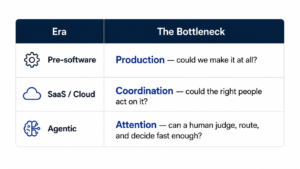
AI Moved the Bottleneck
We spent twenty years building tools to solve the production problem. We built a reasonable set of tools for the coordination problem. We have built almost nothing for the attention problem — and it is now the defining operational challenge of companies running at machine speed.
The New Enterprise Reality
Call your AI deployments what you want — agentic workforce, copilots, your own personal army of very eager interns. The name doesn’t matter. What matters is this: before, your human team took hours or days to produce something that needed your attention. Now your agents produce something every few minutes. Dozens of things per hour. Across every function, every workflow, every timezone.
And every single one of them needs a human to look at it.
You didn’t get less work. You got more work, arriving faster, from more directions, with no filter on whether your judgment actually changes the outcome.
Agentic Sprawl: The Hidden Tax of AI Adoption
There’s a name for what happens when agent deployment outpaces the operating model designed to receive it: agentic sprawl.
More output. More alerts. More approvals. More status loops. More AI-generated work requiring human review — with no shared understanding of what any of it is connected to or whether it needs a human at all. The coordination overhead that AI was supposed to eliminate didn’t disappear. It got faster and louder.
Agentic sprawl is not a sign that AI is failing. It’s a sign that production scaled before routing did. And until routing catches up, every new agent you deploy makes the attention problem worse, not better.
The Insight Most AI Vendors Won’t Say Out Loud
Here’s the uncomfortable truth underneath the attention crisis:
Most enterprise AI products are optimized to generate more output. The next generation will be optimized to protect human attention.
These are fundamentally different design philosophies, and they produce fundamentally different products.
A system designed to maximize output measures success by what it produces — drafts completed, tasks executed, tokens generated. A system designed to protect attention measures success by what it routes correctly: what it handles without escalating to a human, what it defers, what it prepares so that when a human is needed, the decision is fast and confident.
The second kind of system succeeds when humans are interrupted less — not more. That is a radically different objective function. And almost nobody is building for it.
Protecting human attention is a core product behavior, not a feature.
What Routing Attention Actually Requires
To know what deserves a human, a system needs to understand what humans are actually for.
Not every signal requires judgment. Some things should be handled entirely by the agent that raised them. Some should be deferred. Some should be prepared and surfaced with full context so that when a human engages, the decision takes thirty seconds instead of thirty minutes. And some — far fewer than most agentic environments currently send — need a human right now, because judgment, authority, or accountability is genuinely required.
That routing capability — what we call an Attention Orchestration Layer — is the missing infrastructure in human-agent workflows. Not a better model. Not a smarter copilot. An operating layer that understands what matters, what changed, and when a human is actually needed.
This is the reframe that matters: human attention isn’t an infinite escalation target. It is the scarcest resource in a machine-speed organization — and it should be managed accordingly.
The Future Belongs to Companies That Protect Judgment
AI output will grow by orders of magnitude. Human judgment capacity will not. The gap between what agents produce and what humans can meaningfully process will become existential for organizations that don’t have a layer to manage it. Companies will create “AI operations” roles — humans whose job is to triage AI — which is precisely the coordination overhead AI was supposed to eliminate.
The companies that win won’t have the most agents. They’ll have the best signal-to-interruption ratio. They’ll be the ones that decided, early enough to matter, that human attention was worth protecting — and built operating models designed around that principle.
That’s not a feature. That’s a philosophy. And it’s the one that separates AI that creates leverage from AI that creates noise.