

You Don't Have an AI Problem. You Have an Agentic Sprawl Problem.
Your AI adoption numbers look great.
Activity is up. Usage reports are positive. The dashboard is full of green. Somebody made a board slide showing AI engagement climbing quarter over quarter, and it's hard to argue with.
Now answer this: what did it actually change?
Not what it produced. What it changed. Which outcome got better? Which decision got faster? Which customer result improved in a way you can trace to what the AI did?
Most companies deploying AI today can tell you exactly what it generated. Almost none can tell you what it changed.
That gap — between output and outcome — is the most expensive gap in enterprise technology right now.
Output Is Not Outcome
An output is a draft, a summary, a recommendation, a ticket, a report. A thing that was produced. You can count it. AI is extraordinary at producing outputs — faster than any team, at any hour, at volumes that would have seemed impossible five years ago.
An outcome is a customer retained. A product shipped on time. A risk identified before it became a problem. A decision made in two days instead of two weeks. An outcome is something that changed in the world — something the business actually cares about.
AI has no inherent understanding of whether its output serves an outcome. It produces what it was asked to produce. Whether that connects to anything that matters is a design question — and most companies haven't answered it.
The Three Layers of AI Measurement
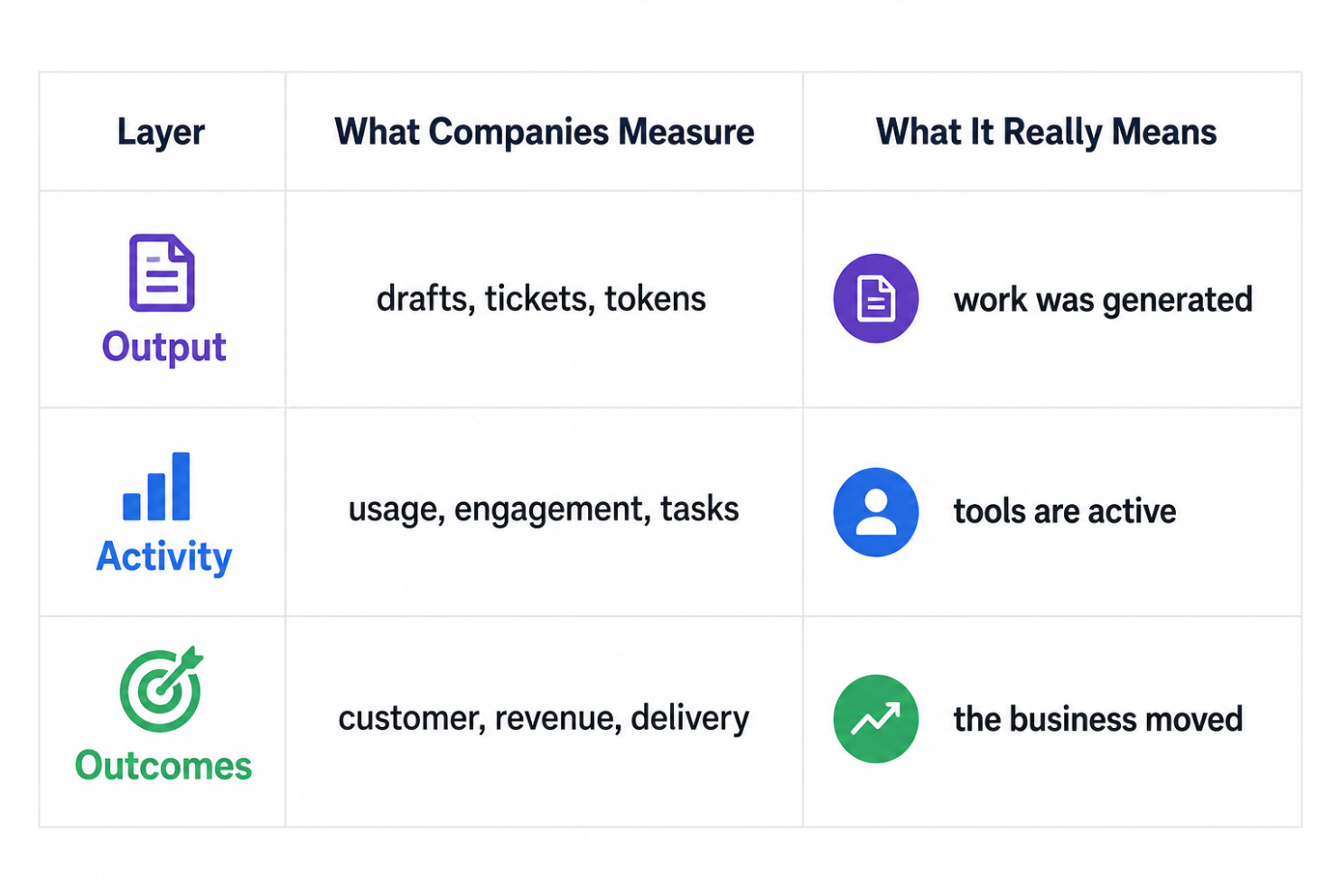
Most organizations are measuring the first two layers. The third is where value lives. Almost no one has built the infrastructure to connect AI activity to it.
The Rational Trap
Nobody made a bad decision getting here. That's what makes this hard to fix.
When the AI moment arrived, companies responded the way they should have: quickly and broadly. Copilots in product. Coding agents in engineering. Support agents in customer workflows. Research agents in operations. Every individual deployment made sense. Someone had a problem, there was a tool that addressed it, the tool got deployed.
The problem is that nobody connected these deployments to a shared model of what the company is actually trying to move. Each agent was optimized for its local context. None had a view of the outcomes the business cared about. The portfolio looks, from a distance, like a strategy. Up close, it's a collection of local optimizations with no connecting tissue.
Agentic sprawl: the gap between AI activity that looks like progress and business outcomes that aren't moving.
Consider a VP of Product preparing for an operating review. She has received fourteen AI-generated summaries in 48 hours — from her analytics agent, her roadmap agent, her customer feedback agent, her sprint status agent. She sits down to answer the one question the review actually requires: why did onboarding conversion decline last quarter?
She can't answer it. Not because the information doesn't exist somewhere in those summaries. But because no agent knew that answering that question was the point. Each reported on its own domain. None connected the dots. Now she does it manually, under time pressure, the same way she would have before any of the agents existed.
More output. No operational leverage.
What Agentic Sprawl Actually Costs
The expense compounds through three mechanisms — each more damaging than the last.
Output without traceability. More production than ever, with almost no way to trace it to impact. Which summary informed which decision? Which recommendation changed anything when acted on? The paper trail got longer and less useful simultaneously. When finance asks what the AI investment returned, there is no layer that can answer — because no layer was built to connect activity to outcomes.
Approvals without context. Agents generate work requiring human sign-off. But the approval arrives stripped of what would make it meaningful — no evidence, no connection to the outcome it serves, no explanation of consequence. The approver reconstructs the decision from scratch, every time. Multiply that by the volume agents produce and you've created a new full-time job: reviewing AI work in order to authorize AI work.
Coordination overhead nobody predicted. AI was supposed to reduce the management layer between work and outcomes. Without a live operational context layer, it expands it. More status meetings, more synchronization overhead, more escalations when agent work in one domain affects outcomes in another. The irony is precise: the tools deployed to reduce coordination created a new coordination layer on top of the old one.
Why ROI Stays Murky
AI ROI is hard to prove not because the tools are weak — many are genuinely impressive — but because there is no shared operational context connecting AI activity to the results companies are organized around.
You can count outputs with a spreadsheet. You cannot attribute outcomes without a shared model of work.
Attribution requires knowing: what outcome was in flight, what its state was before the AI acted, what the AI did, what changed after, and whether the change was because of the AI. That chain requires a live connected model tracking outcomes, decisions, dependencies, and agent activity together. Most companies have tool-level logs and team-level anecdotes and a quarterly review that reconstructs what happened after the fact.
Without attribution, every AI investment is an act of faith with a good-looking dashboard. When finance asks what we got for this — which they will — you're left measuring tokens and hoping that translates into something the CFO finds compelling. It usually doesn't.
You Don't Fix Agentic Sprawl by Adding Better Agents
This is the insight most AI vendors don't want you to reach.
More capable models don't fix the outcome disconnect. A better agent still optimizes for its local system, not for the business outcome. A faster agent still produces output without a view of whether that output is the right next thing for the company — or just the next thing it's capable of producing.
Agentic sprawl is not a model problem. It is an operating design problem.
The fix is not better agents. It's building the organizational context layer that connects agent work to outcomes — so every agent, every human, and every decision operates from the same live picture of what the company is actually trying to move. When that layer exists, AI activity becomes attributable. The question changes from "are we using AI?" to "can we prove what it moved?"
Outputs scale automatically. Outcomes don't.
The companies that build the connection between the two first will have a compounding advantage: every piece of agent work enriches the operational model, and a richer model makes every subsequent agent smarter. That is the flywheel that turns AI activity into AI leverage.
Originally published on LinkedIn on June 1, 2026.