Your Agents Are Capable. Your Company Is Unreadable.
You've deployed AI across the company. Your agents can analyze, draft, summarize, triage, investigate, and execute across dozens of workflows. The tools work. The usage is real. The question is whether they know what matters.
Now ask one of those agents: what's the next right thing to do to move this outcome forward?
Not "summarize this document." Not "draft a response to this email." Ask it what should actually happen next — in your company, on this initiative, given everything that's true right now — to move the needle.
It will hesitate. Or it will give you something plausible but generic. Or it will produce something confident that misses the actual context by a mile.
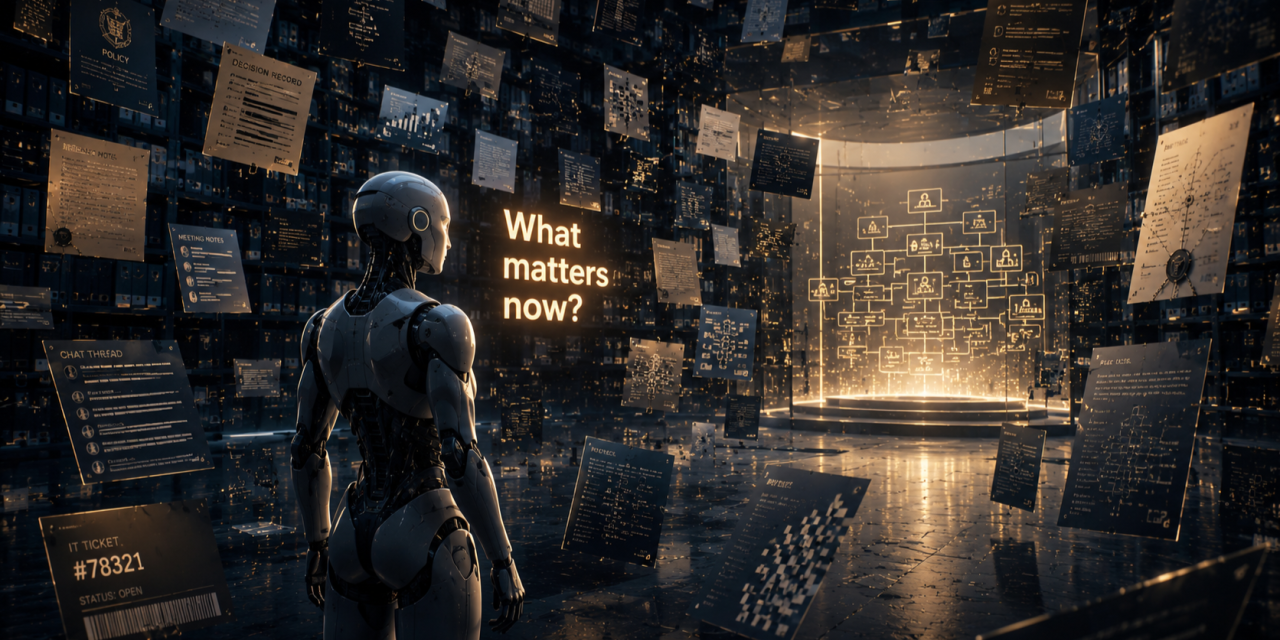
That's not a model failure. The agent can't read the company.
A company is unreadable to agents when the information they need to act well exists somewhere — but not in a form they can reliably read, connect, or trust.
That is the root cause underneath the attention bottleneck, the outcome attribution gap, and the anticipation problem.
Better models won't fix it. A smarter agent is still guessing if the company itself cannot be read.
The Problem Isn't Action. It's Knowing What Action Matters.
Every useful agent action comes down to one question: what should happen next to move this outcome forward?
To answer that, an agent needs the operating state of the company: the outcome in motion, the current state, the blockers, the decisions already made, the owners, the authority boundaries, and the rules that apply.
That is not just lookup. It is not solved by retrieval alone. It requires a live, connected model of how your company actually operates — what's in motion, what matters, and what's true right now.
Without that model, an agent cannot identify the next useful action. It can only produce the next plausible one. And plausible and right are not the same. In high-stakes decisions, they are very different. In fast-moving situations, the gap compounds.
When agents can answer that question reliably — when the operating model is readable — they stop being expensive autocomplete and start being genuine leverage. Everything else is secondary.
Humans Carry the Missing Map
Your best senior operators can answer the "next right thing" question reasonably well, even across complex, ambiguous, multi-team situations. They don't have perfect information. But they navigate.
How? They carry mental models built over years. They know who to call when something seems off. They know which number to trust and which is stale. They know when official policy and actual practice have diverged. They know what the data is really saying because they remember the decision made three months ago that makes this week's numbers make sense.
That knowledge is almost entirely unstructured. It lives in heads, relationships, unwritten habits, and meeting memories — context never captured because everyone in the room already had it.
Humans can navigate unreadable companies because they build their own private map through lived experience.
Agents can't do that. They don't have years. They don't have relationship context or institutional intuition. They need the scattered operating context of the company to exist somewhere structured, live, and trustworthy — or they are flying blind. And right now, for most companies, it doesn't.
The Company Knows. The Agent Doesn't.
Let's make this concrete. Ask the questions an agent needs to answer — and notice where the answers actually live.
What outcome does this work serve?
Probably in a doc written at the start of the quarter, possibly updated once, likely not current.
What was decided in the last review?
In someone's notes. Maybe written up, maybe not. Almost certainly not connected to the work that followed from it.
What's blocking this right now?
Three people know. None of them are the agent. The agent can see the ticket. It cannot see the Slack DM where the actual blocker was identified and assigned to someone who hasn't reported back.
What approval is required before this moves?
Depends on who you ask. The process document says one thing. What actually happens says something different. The agent has access to neither.
What policy applies?
Written in a document from 18 months ago. May or may not reflect current practice. The agent has no way to know.
Without live answers to these questions, the agent doesn't know the next useful action. It knows the next generically reasonable one. In most operating situations, those are not the same thing.
Better Models Won't Fix a Company They Can't Read
More capable models do not fix fragmented company context. A model that is 10% better at reasoning will not reconstruct the decision made in a meeting last month and never written down. It will not surface the dependency that exists in someone's head but not in any system. It will not know that the policy it's reading is the old version.
Better retrieval doesn't fix it either. You can give an agent access to every document, every ticket, every Slack thread. If those sources are incomplete, stale, or disconnected from each other, the agent still cannot identify the right next move with confidence.
This problem predates AI. It is the operating challenge every scaling company faces: the company's operating reality becomes more complex than any system captures, and humans bridge the gap with experience and judgment.
AI makes it urgent in a new way, because we are now asking agents to do work that requires that operating reality — and discovering, in real time, that it isn't there in a form they can use.
What It Takes to Make a Company Readable
Making a company readable is not a documentation project. It is a live infrastructure problem. Here is what agents actually need — and where that information lives today.
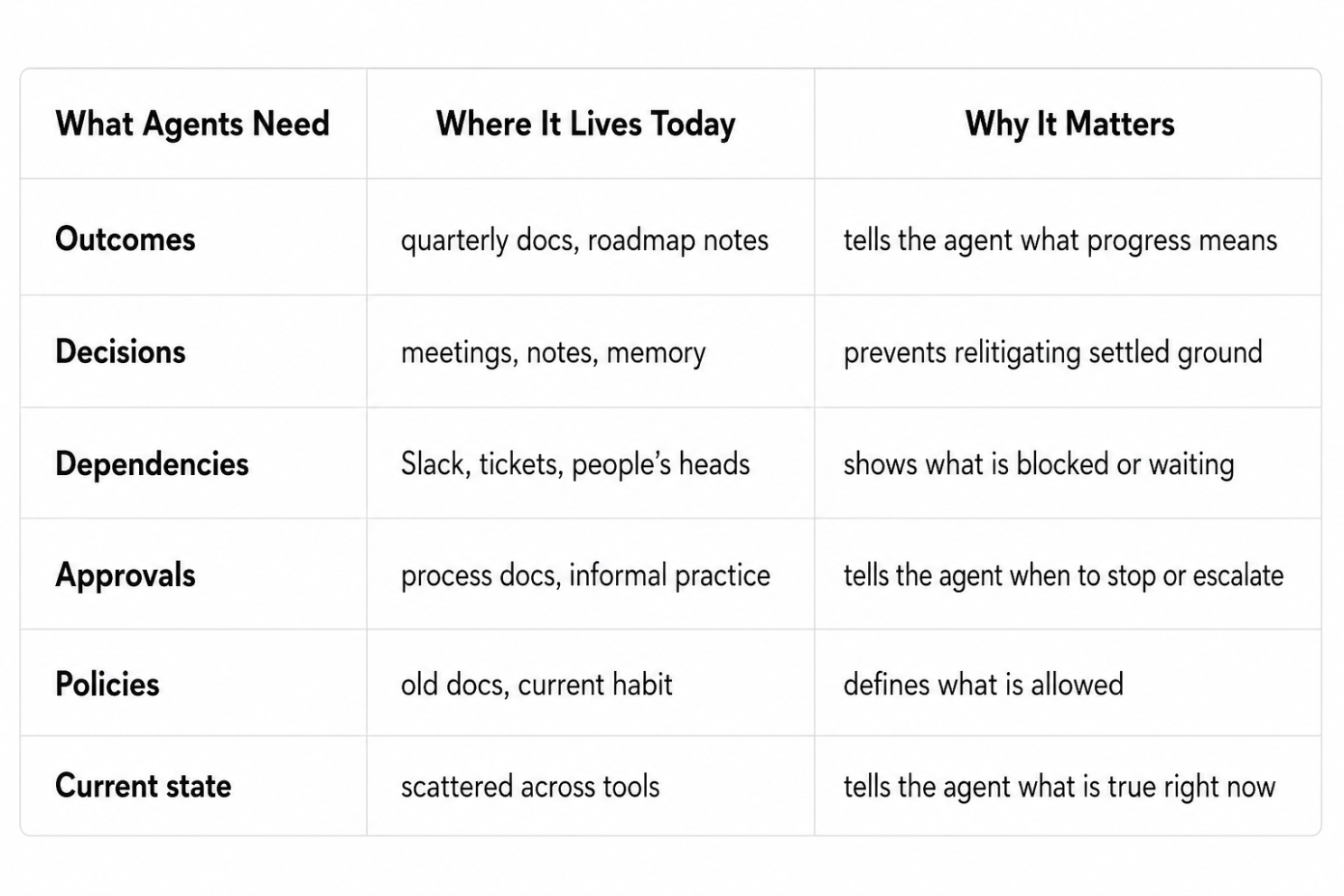
Each row represents a gap between where the information lives and where it needs to be for an agent to act with confidence. Closing those gaps is the work of making the company readable — and it is the prerequisite for AI that actually moves outcomes rather than generating activity around them.
The Advantage Goes to Companies Agents Can Read
There is a version of enterprise AI where companies keep deploying agents on top of an unreadable operating model, wonder why ROI is hard to demonstrate, and spend years chasing the promise of AI productivity without ever arriving.
And there is a version where companies make themselves readable first — where the scattered operating context of the company becomes structured, live, and connected — and find that every agent they add after that point works better than the ones before it. Because the context they're working from is richer. Because the right next action is no longer a guess.
The second version compounds. The first doesn't.
AI does not just need better models.
It needs companies it can read.
Until then, every agent is guessing.
Originally published on LinkedIn on June 15, 2026.