
The Anticipation Gap: Why Reactive AI Still Feels Like Work
You were sold delegation. What you got was supervision.
Most AI agents still require you to know exactly what to ask, supply the missing context, evaluate the answer, correct the misses, and decide what to do next. The tool is faster. The cognitive burden never fully leaves you.
This is different from the attention crisis of too much AI output arriving for humans to process. The anticipation gap happens one layer earlier: even before the output arrives, humans still carry the full cognitive weight of knowing what to ask, when to ask it, and whether the result is any good.
That exhaustion is not user error. It is a product problem. And almost nobody is naming it.
Why Reactive AI Still Feels Like Work
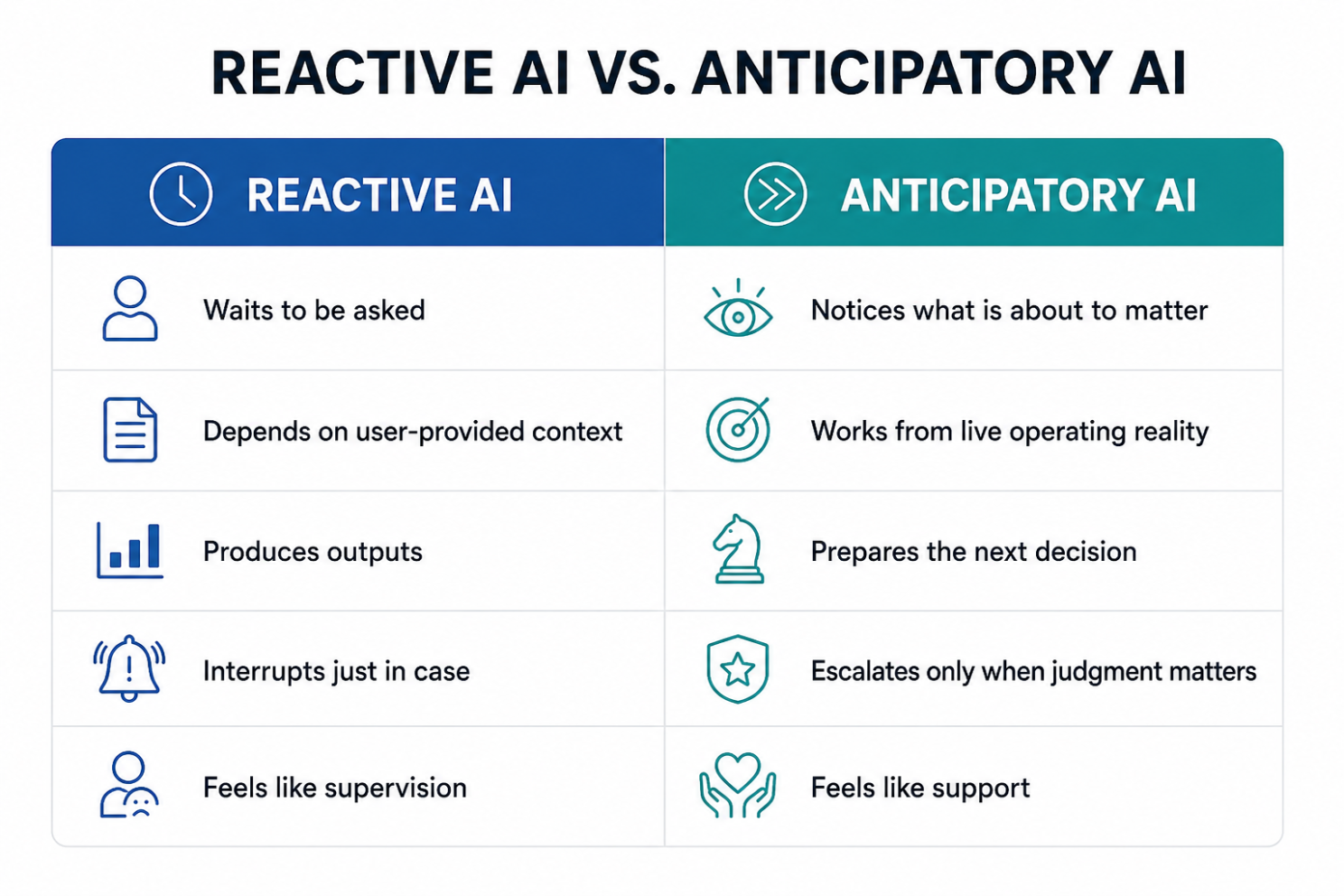
The core issue is simple: almost every AI agent available today is reactive. It waits for you to open it. It waits for you to describe what you need. It does what you ask, as well as it can, with the context you provide.
That sounds like help. But reactive AI leaves the hardest cognitive job entirely with you — figuring out what to ask, in what order, with what surrounding territory covered, and whether the answer is actually right. Those are not small jobs. They are often the whole job.
This is not delegation. This is supervision with extra steps.
And supervision at scale is its own full-time job. By end of day, you've worked harder to get slightly faster results — and wondered whether the whole category is oversold. The category is not the problem. The design target is.
The Cognitive Tax You Can't See
The tax is not in any single interaction. It's in the accumulation.
With a human team member you trust, you can hand something off and genuinely let go. You don't have to hold the context in your head while they work. You trust that they understand not just the task but the surrounding territory — what matters, what the real constraints are, what would make you nervous about a given approach.
With most AI agents, you can't fully let go. That is where the cognitive tax begins.
You have to hold enough context to evaluate what the agent brings back. You have to stay close enough to catch the confident-sounding wrong turn before it compounds. You are not a delegator. You are a supervisor who is always on call.
The cruelest version: you asked the agent to save you time, and you spent the time you saved managing the agent.
Most Proactivity Is Just Interruption in Disguise
There's a version of AI proactivity that sounds good and fails in practice: the agent that sends you nudges. The one that says "don't forget about this" or "here's something relevant" — based on shallow pattern matching over your calendar and email, with no real understanding of what actually matters.
That's not proactivity. That's ambient interruption with a friendly tone.
The agents that do this most confidently — surfacing irrelevant things with cheerful urgency — are in some ways more exhausting than the ones that simply wait to be asked. They add noise while appearing to add value.
Real anticipation is different. It's something happening — the right thing, at the right moment, without you having to think about it — that makes your day feel lighter instead of adding another thing to track.
What Useful Anticipation Requires
The gap between reactive AI and genuinely anticipatory AI is not a model capability problem. It is a context problem.
To anticipate, an agent needs to know what's coming before you ask. That requires three judgments most agents cannot yet make reliably:
1. What is likely to matter next? Not what did you ask for — what is the live state of work signaling is approaching? What outcome is at risk? What decision is forming that will need context assembled?
2. What can be prepared before being asked? Evidence, options, tradeoffs, recommendations — ready before the human discovers they need them. The goal is to eliminate the setup cost of getting to a decision.
3. Is this worth interrupting a human for? The hardest one. Knowing the difference between signal and noise. Defaulting to quiet when in doubt. An agent that stays out of the way when nothing requires a human is more valuable, not less, than one that surfaces everything just in case.
Anticipation Without Context Is Just Faster Guessing
Anticipation is not magic. It is pattern recognition over the live state of work.
To prepare the right thing before you ask, an agent needs to know what outcomes are in flight, what's at risk, what has changed since yesterday, what decisions are pending, and what's blocked. Without that shared model of work, even the most capable model is guessing about what to prepare — and guesses, surfaced at agent volume and frequency, become noise.
Anticipation is impossible without operational context. Without it, proactivity becomes just another form of agentic sprawl — more interruptions, more things to evaluate, more cognitive load disguised as help.
With a live, structured model of how the company actually operates, anticipation becomes learnable. The agent gets better at knowing what matters because it understands, in a current and structured way, what the company is actually working on.
The Breakthrough Product Will Know When to Shut Up
The agents that will actually change how people work will be remarkable not for how much they produce, but for how well they know when not to.
The most useful agent you will ever work with will be one you barely notice — because it handled what it could handle, prepared what needed preparing, and only came to you when your judgment would have actually changed something. You'll be less interrupted. You'll make better decisions with less effort. Work will feel lighter in a way that's hard to attribute to any single moment, because the friction was removed before you encountered it.
That is the anticipation gap. The distance between AI that is technically capable and AI that is actually helpful — experienced not as a tool that needs managing, but as a system that has your back.
The anticipation gap is one of the defining product problems in practical AI. Closing it starts with acknowledging what reactive AI really costs: not tokens, not task completions, but cognitive overhead that never fully leaves the humans it was supposed to help.
Originally published on LinkedIn on June 8, 2026.