Quantum Readiness Isn't a Technology Decision. It's an Operating Model Decision.
Why the next eighteen months will sort companies into two groups — and qubit count alone won't be the variable that matters
Last year, McKinsey's Quantum Technology Monitor 2026 put a number on something a lot of executives had been sensing anecdotally: investment in quantum computing hit $12.6 billion in 2025 — a 6.3x increase over the year before. More tellingly, the composition of that money flipped. In 2024, a third of it came from governments and public institutions. In 2025, that share fell to 3%. Private capital — venture funds, strategic investors, public markets — took over almost entirely.
That's not a story about physics getting better twelve times faster. It's a story about risk perception changing. When the people allocating capital shift from "let's fund the science because someone should" to "let's fund the companies because there's a return," something has crossed a threshold.
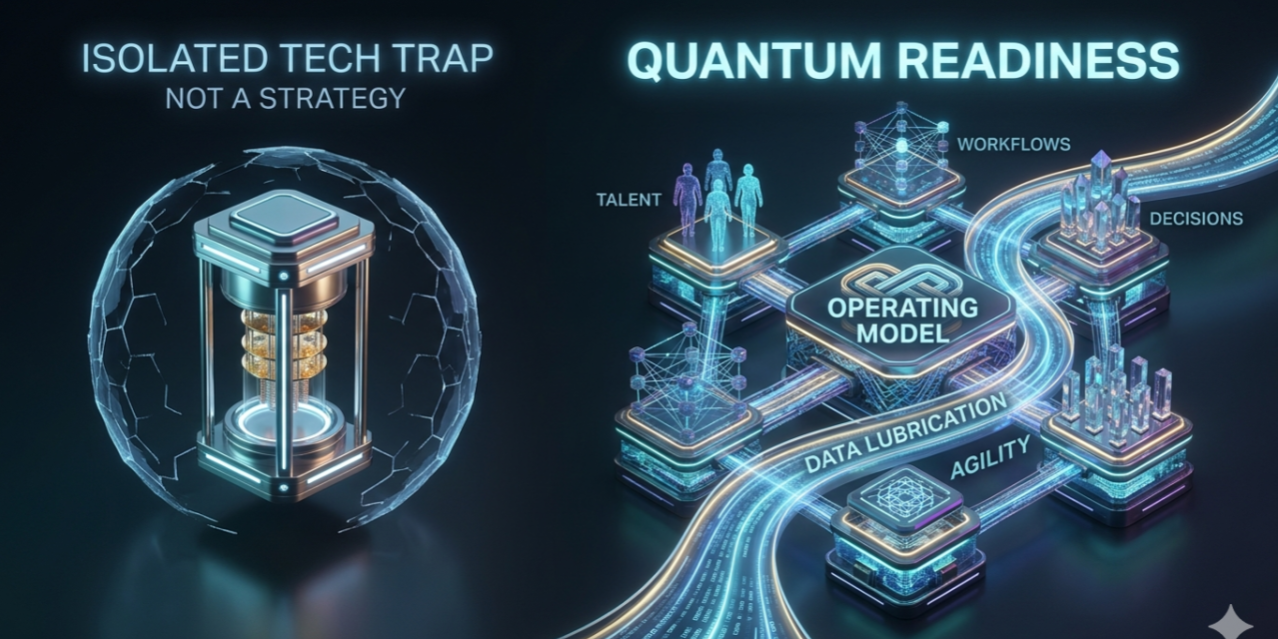
McKinsey called it a commercial tipping point. I'd call it something slightly different: the moment quantum stopped being a research question and became a readiness question. And readiness is not a technology problem. It's an operating model problem — the same one I've spent most of my career on, and the same one that quietly determined who actually got value out of the AI wave and who just bought a lot of licenses.
The mistake companies are about to repeat
Here's the pattern from the last major wave of "is this real yet" technology, and I think most leadership teams will recognize it.
Around 2022 and 2023, a huge number of companies treated "AI strategy" as a procurement exercise. Which model? Which vendor? Which cloud? The org chart didn't change, the decision rights didn't change, nobody owned the question of how an AI-generated output actually entered a real business process — but the company could now say it had "an AI strategy," because it had a contract.
Two years later, the gap between companies that got measurable value from AI and companies that got a line item in the IT budget wasn't explained by which model they picked. It was explained by whether anyone had redesigned how decisions got made, who was accountable for outcomes, and how a probabilistic output got integrated into a process that used to assume certainty.
Quantum is about to offer the same trap, on a longer fuse. The procurement question — "which architecture, which vendor, which cloud quantum service" — is the easy one, and it's the one most companies will spend their first cycle of attention on. It is also, almost certainly, not the question that will determine whether your organization gets value from quantum computing in the 2028-2032 window when some credible roadmaps aim to cross from "demonstrated" to "useful."
It's also worth being clear that "quantum" isn't one timeline. Optimization and certain simulation workloads are tracking toward useful results on a different schedule than large-scale cryptographically-relevant computation, and quantum sensing and networking follow yet another timeline again. A readiness plan that treats "quantum" as a single undifferentiated future will misjudge urgency in both directions — too alarmed about the parts that are genuinely far off, and not alarmed enough about the parts that aren't.
Three questions that have nothing to do with qubits
If I were advising a leadership team building a quantum readiness plan today, I would not start with hardware. (I work in the quantum industry, so I am deliberately avoiding an architecture bet here — the executive question is readiness, not vendor selection.) I'd start here:
1. Who owns this question, and do they have the authority to act on an answer?
Right now, in most organizations, "keep an eye on quantum" has been informally assigned to someone in R&D, innovation, or the CTO's office, usually as a fraction of their time. That's fine for monitoring. It is not fine for readiness, because monitoring without decision rights produces exactly one outcome: a very well-informed person who can't get budget approved when something becomes actionable. Decide now who has both the mandate to track this and the authority to propose a pilot when the moment arrives — even if the answer today is "not yet."
2. Does anyone in the building have enough literacy to evaluate a vendor claim?
Not a PhD. Literacy. The difference between a benchmark result and a business result. The difference between "quantum computing," "quantum-inspired algorithms running on classical hardware" (which are deployable today, for the record), and "quantum sensing or networking" — three different technologies on three different timelines that get conflated constantly in vendor decks. Without this, your organization's quantum strategy is whatever the most persuasive vendor tells you it is.
3. If a quantum-assisted result landed on someone's desk tomorrow, what would happen to it?
This is the operating model question, and it's the one almost nobody asks. HSBC's September 2025 result — up to a 34% relative improvement in bond trading prediction performance using IBM's Heron processor — is interesting not because it proves quantum trading has arrived (it doesn't, and HSBC was careful to say so). It's interesting because HSBC clearly had a pathway for a novel computational result to reach a trading decision process in a way that could be measured against existing methods. That pathway — the integration, the validation framework, the willingness of a trading desk to even look at the output — took organizational work that has nothing to do with quantum mechanics. Most companies don't have that pathway for any experimental computational method, let alone a quantum one.
The asymmetry that should worry you
Here's the uncomfortable part. Building organizational readiness — decision rights, literacy, integration pathways — takes about the same amount of time regardless of which architecture eventually wins, or how fast the hardware timeline moves. Eighteen months, roughly, for a mid-sized enterprise to go from "nobody owns this" to "we have a credible pilot pathway and someone who can sit across from a vendor and ask the right five questions."
The hardware timeline, on the other hand, is genuinely uncertain — and multiple credible paths (superconducting, trapped-ion, neutral atom, photonic, topological) are being pursued in parallel by well-capitalized companies, each with different strengths and different schedules. Nobody — including the companies building the hardware — can tell you with confidence whether the breakthrough that matters for your industry lands in 2027 or 2031.
Which means: the operating model work is the only part of this you can actually schedule. And it's the part that, if you start now, costs you almost nothing if the hardware timeline slips — because a leadership team with quantum literacy, clear ownership, and an integration pathway for experimental computational results is also better at AI, better at any other emerging technology decision, and better at making good "no, not yet" calls instead of expensive "yes, because everyone else is" calls.
What to do Monday
None of this requires a budget line or a hardware decision. It requires four things, all of which can start this week:
– Appoint an owner. Someone — likely already in R&D, innovation, or the CTO's office — gets explicit accountability for quantum readiness, with the authority to propose a pilot when the time comes.
– Inventory your use cases. A short list of the problems in your business that look like optimization, simulation, or pattern-recognition problems — the categories where quantum and quantum-inspired approaches are most likely to be relevant first.
– Schedule a vendor-neutral briefing. Not a sales pitch from a single vendor — a literacy session that gives your owner and a handful of stakeholders a shared, accurate vocabulary.
– Define your pilot decision gate now. Decide, in advance and without a specific vendor in the room, what evidence would justify a pilot — so that when a credible opportunity arrives, you're evaluating it against a standard you set in advance, not one a vendor proposes in the moment.
The companies that will look smart in 2029 aren't the ones who guessed the right architecture in 2026. They're the ones who spent 2026 building the muscle to recognize a real opportunity when one actually arrived — regardless of whose logo was on it.
Quantum readiness is not about predicting the winning architecture. It is about building the organizational machinery to recognize and integrate useful capability when it becomes available. That's not a technology bet. It's an operating model decision — and unlike the hardware roadmap, it's entirely within your control, starting now.
Originally published on LinkedIn on June 22, 2026.