
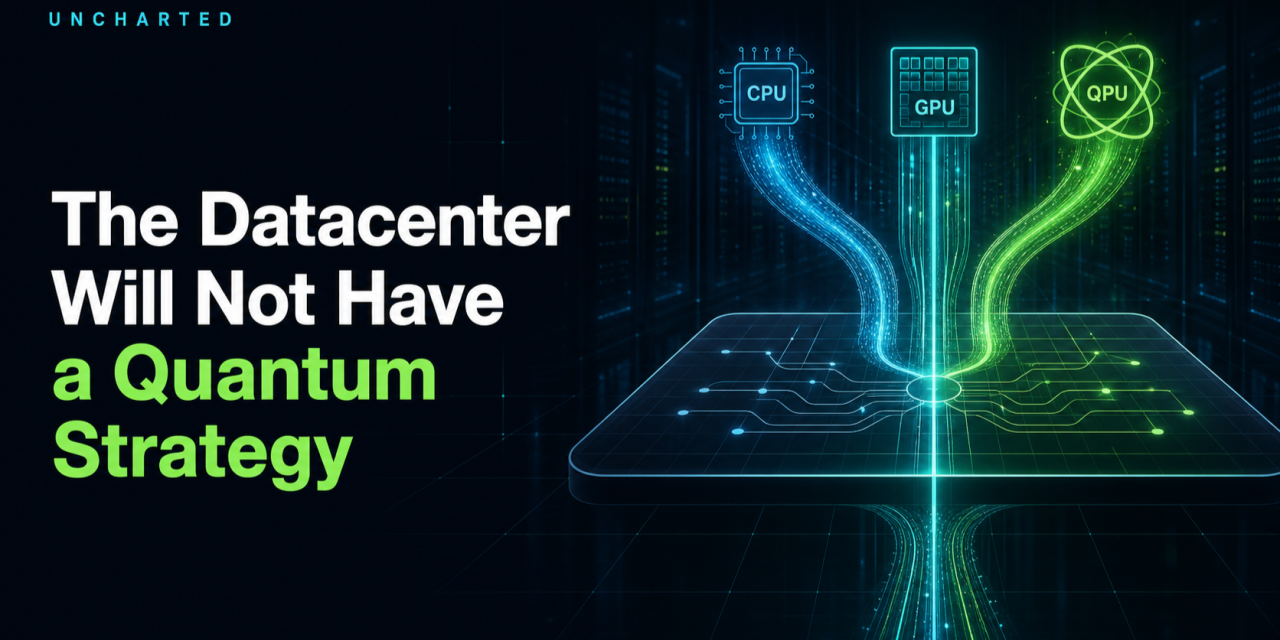
The Datacenter Will Not Have a Quantum Strategy. It Will Have a Scheduling Problem.
Picture what actually happens, some years from now, when quantum computing becomes useful to a company that is not in the quantum industry.
Nobody signs a purchase order for a quantum computer. Nobody stands up a quantum division. A workload that used to run entirely on classical infrastructure acquires a step that runs somewhere else, and something has to decide when that step happens, in what order, against which queue, with what data staged where.
That is the shape of it. Not a strategy question. A workload placement question, arriving inside infrastructure people already own and already argue about.
Three Ways a Workload Can Use a Quantum Resource
The first correction to make is that "hybrid workload" describes at least three quite different things, and they have different infrastructure consequences.
Batch. A problem is prepared, submitted, and the result collected later. Coupling is loose. This behaves like any other queued job and is how most quantum work is done today.
Iterative with a moderate loop. Classical processing decides what to submit next based on the previous result, but the loop tolerates seconds. Variational approaches broadly sit here.
Tightly coupled. The classical and quantum sides exchange information within the execution of a single computation, on timescales where the round trip is architecturally significant.
Most of the interesting infrastructure questions come from the third category, and some come from the second. But if all you ever run is batch, most of this article does not apply to you, and it is worth knowing which category you are actually in before designing around the hardest case.
For the tightly coupled case, the unit of work is not "a quantum job." It is a classical process that repeatedly needs a quantum answer within a bounded time. Everything architecturally interesting follows from that sentence.
Where the GPU Analogy Holds
The comparison people reach for is graphics processing units, and it is genuinely useful in four respects.
It is an accelerator, not a replacement. Nobody replaced their CPUs with GPUs. They added a specialised unit for a narrow class of work and kept everything else where it was.
It arrived inside existing infrastructure. GPUs became an enterprise capability as a scheduling and capacity question inside facilities people already ran, not as a strategic bet approved by an innovation committee. Access, quotas, queues, chargeback.
It was consumed as a service long before it was owned. For most organisations it still is. Quantum is starting further along that same curve.
It needed an abstraction layer before it was useful to anyone normal. GPUs became broadly valuable when frameworks let people use them without writing kernels. Quantum's equivalent layer is immature, and its maturity is a better leading indicator of enterprise relevance than any hardware milestone.
Where It Breaks
The analogy is a useful entry point and a poor operating model, because four differences appear quickly.
Results are probabilistic. A GPU returns an answer. A quantum processor returns samples from a distribution, from which you infer an answer. Scheduling something whose output is statistical changes what "the job finished" means.
The machine's characteristics vary over time. Quantum processors drift and require recalibration. Availability windows and performance are not constant in the way a GPU's are. A scheduler assuming homogeneous, stable units does not survive contact with that.
Units are less interchangeable. Any GPU of a given generation runs the same compiled workload. Quantum hardware differs by modality in native gate sets, connectivity and error characteristics. Portability does exist at higher levels of abstraction, and toolchains are built precisely to target multiple back ends from one description. But the compilation is not free and the resulting performance can differ substantially, so this is not a commodity pool in the way a GPU fleet is.
For tightly coupled workloads, latency is the binding constraint rather than bandwidth. You do not stream terabytes into a quantum processor; the submitted circuit is small. What matters is the round trip time of a loop repeated many times. For batch workloads the picture is different, and queue depth and data staging matter more than round trip.
Take those together and quantum resembles a GPU in how it enters an organisation and much less in how it behaves once there.
Scheduling, Routing, and Why They Are Not the Same
These get used interchangeably and they are two different capabilities.
Scheduling decides when and where a known job runs. Queue management, capacity allocation, priority, fair share. Mature discipline, decades of tooling.
Workload placement decides which class of compute a piece of work should be handled by in the first place. That is a design and economics judgement rather than an operational one, and it has to be revisited as the answer moves.
Call the second one the routing problem if you want a label that sticks, but workload placement is the term to use when you are trying to find somebody who owns it.
Most enterprises today place workloads by habit. Things run where they have always run, on the infrastructure the owning team knows, until something breaks badly enough to force a review. That has been survivable while the meaningful choices were between broadly similar options.
It becomes expensive when the estate contains genuinely heterogeneous compute with different economics, and when the right answer for a given workload changes every eighteen months as one class of hardware improves faster than another. Some organisations are learning this with GPUs right now, which is a useful rehearsal.
So the question is not whether your company will use quantum computing. It is whether anyone currently owns the decision about where a workload should run, with the authority and information to change it. In most organisations that role does not exist. The decision is an accumulation of defaults nobody has revisited.
Why This Direction Deserves Attention
I have written separately about why error-corrected quantum systems need substantial classical compute running alongside them, and why that pushes deployment toward facilities built for high performance computing. I will not repeat the argument here.
The relevant consequence is this. Once a quantum resource sits in a facility that also runs other classes of compute, there is an obvious question about whether they should be scheduled together, and an obvious cost argument for doing so.
That is a reason the architecture deserves attention, not a prediction that it will arrive. Shared scheduling across genuinely heterogeneous compute is hard, and current practice is closer to co-location with separate queues than to a unified scheduler making intelligent placement decisions. Some workloads will remain better served by dedicated access. Some organisations will never touch quantum resources and will be right not to. And the software layer that would make placement decisions automatic does not exist in a form anyone would trust with production.
What makes the direction worth watching is that the physical constraints and the cost arguments point the same way. That is weaker than inevitability and stronger than speculation.
Who Should Care
If quantum arrives through infrastructure, the people who need to understand it are the ones who already run capacity, scheduling and cloud relationships.
In most organisations those people are absent from the quantum conversation, which is being conducted between a strategy function and a vendor. That is worth fixing early, not because a decision is imminent, but because the people who would eventually have to operate this are currently learning about it from press releases.
The Question
When a quantum-accelerated workload becomes available to your organisation, who decides whether to use it?
Name the actual role. Then ask whether that person is in any quantum conversation you are currently having, and whether they own the equivalent decision for GPUs today.
If the answers are no and no, the gap is not a quantum gap. It is a workload placement gap that already exists and that quantum will make more expensive. I would like to hear from anyone whose organisation has genuinely made placement a named responsibility, because I have not seen many.
Originally published on LinkedIn on September 1, 2026.