The AI Metric Nobody Is Tracking — And Why It Will Define the Next Five Years
There is a metric that most companies running AI workflows aren't tracking. It doesn't appear on any vendor dashboard. Nobody mentions it in quarterly AI reviews. But it may be the single most predictive measure of whether an organization's AI investment creates leverage — or just noise.
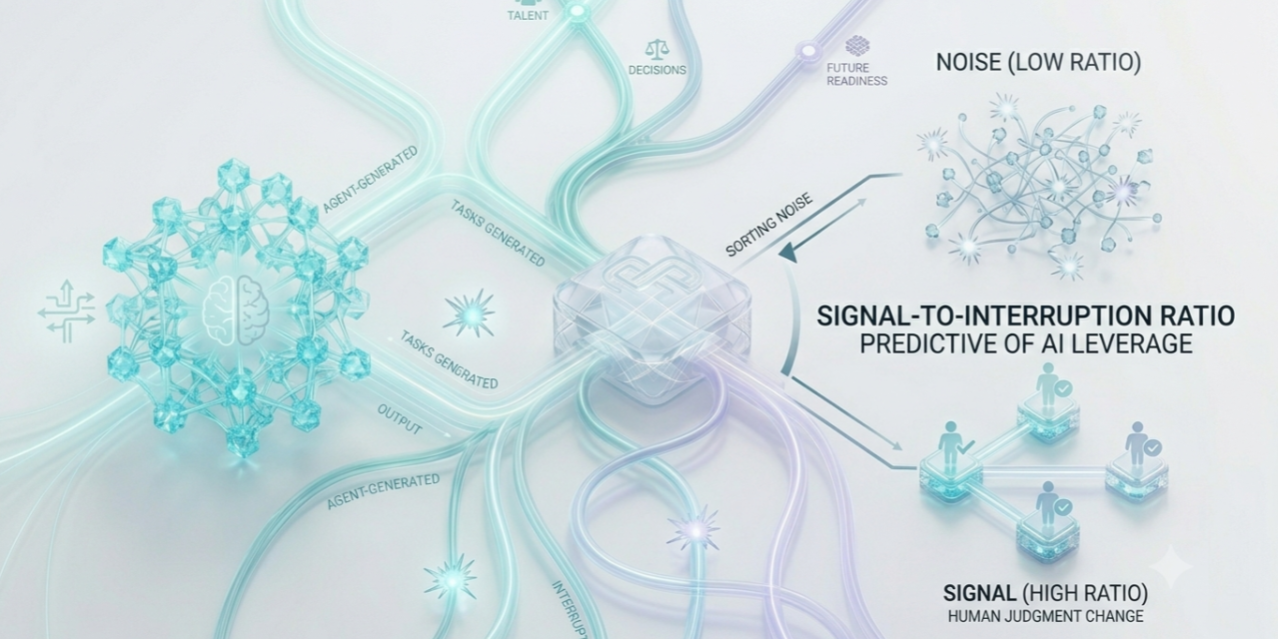
The signal-to-interruption ratio: the proportion of agent-generated interruptions that actually required human judgment versus those that didn't.
If that number is low — if most of what reaches a human could have been handled, deferred, or prepared by the system — then AI isn't reducing cognitive load. It's redistributing it upward. The humans with the most judgment are spending the most time on the least judgment-dependent work. And the whole promise of AI leverage quietly evaporates.
Why This Metric Doesn't Exist Yet
Most organizations measure AI by output. Tasks completed. Drafts generated. Tokens consumed. Hours theoretically saved. These metrics are easy to collect and easy to present. They say nothing about whether the AI improved the quality of human decision-making or protected the time of the people doing it.
The signal-to-interruption ratio is harder to measure because it requires knowing two things simultaneously: what the AI surfaced, and whether a human's involvement actually changed the outcome. That second question — did the human's judgment matter here? — requires a model of the work, the decision, and what would have happened without the interruption.
Most AI systems don't have that model. They surface everything and let humans sort it. The sorting is efficient from the system's perspective. It is expensive from the human's perspective. And the cost is invisible in every metric the system reports.
How to Measure It
The ratio does not need to start perfect. A company can approximate it by sampling escalations and asking three questions: Did this require human judgment? Did the human change the outcome? Did the request arrive with enough context to decide quickly? Over time, those answers reveal whether AI is protecting attention or consuming it.
More precisely:
Numerator: interruptions where human judgment changed or materially validated the outcome.
Denominator: all agent-generated interruptions routed to humans.
Quality adjustment: whether the interruption arrived with sufficient context.
A ratio approaching 1.0 means humans are almost always receiving items that require them. A ratio near 0 means humans are sorting noise. Most organizations have no idea where they fall — and that is itself a signal.
What a Bad Ratio Looks Like
A bad signal-to-interruption ratio has a recognizable texture, even before you name it.
Leaders spend the first hour of their day reviewing AI outputs that range from "needs action" to "interesting" to "why was I sent this." They approve things they didn't fully read because the volume is too high for deep engagement with every item. They develop a habit of checking everything quickly and trusting that the important ones are in there somewhere.
Meanwhile, genuinely important signals — a dependency about to block a launch, a decision drifted out of alignment, a risk approaching a threshold — arrive in the same feed as the noise. They get the same attention the noise gets: quick. Sometimes that's enough. Sometimes it isn't.
The failure mode is not dramatic. It's the approval granted without enough scrutiny. The risk dismissed because it looked like the ten other false alarms this week. The decision that needed 20 minutes and got 90 seconds.
What a Good Ratio Looks Like
A good signal-to-interruption ratio means that when something reaches a human, it almost always required a human.
The routine was handled by the system. The low-ambiguity was resolved within policy. The preparable was prepared — evidence gathered, options surfaced, context assembled — so that when a human does engage, the decision is fast and confident rather than slow and reconstructed from scratch.
A high signal-to-interruption ratio does not mean fewer humans involved. It means human attention is concentrated where judgment changes the outcome. The goal is not automation-at-all-costs; it is ensuring that the humans who need to be involved are involved, and that everyone else is protected from noise that doesn't require them.
What Good Routing Looks Like by Function
The routing logic varies by function, workflow, and what constitutes a decision that actually needs a human:
Customer success: escalate renewals only when sentiment, usage trends, or commercial exposure crosses a defined threshold. Everything below can be prepared, summarized, and queued — not escalated.
Product: interrupt leadership only when a dependency threatens a committed milestone, not for every status update or minor change. Progress within plan should flow without interruption.
Finance: route exceptions only where policy, confidence level, or financial impact exceeds delegated authority. Transactions within approved parameters should not require human review.
In each case, the signal-to-interruption ratio improves not by routing less — but by routing more precisely.
The Ratio as a Competitive Variable
Organizations with a high signal-to-interruption ratio get more from the same human talent. Their leaders make more decisions per day, each one better prepared, with lower cognitive switching cost. The compounding mechanism: lower interruption cost creates faster decision cycles, more willingness to delegate consequential work, higher trust in AI routing over time, and better use of scarce expert attention. Each improvement reinforces the next.
Organizations with a low ratio get the opposite. Their leaders are busier than ever and less certain than before. Their AI investments plateau — not because output declined, but because the human capacity to absorb and act on output didn't scale with it.
Over five years, those trajectories diverge — and the mechanism is clear: better routing creates better decisions, which creates more trust, which enables more delegation, which generates more leverage from the same talent.
How to Move the Ratio
Improving the signal-to-interruption ratio is not primarily a model problem. For many enterprise workflows, the limiting factor is no longer only model capability. It is operating design: whether the system knows what should be escalated, prepared, deferred, or handled within policy.
The system needs to know what matters. That requires a live model of outcomes, decisions, dependencies, and risk thresholds — the operating context that tells a routing layer whether an item is urgent, whether it falls within existing delegation, and whether a human would actually change the outcome by engaging.
The companies that build this operating context first will have a routing layer that gets smarter over time — because every correctly routed item, every human correction, every deferral that turned out to be right makes the model more accurate.
The signal-to-interruption ratio will not appear in your AI vendor's onboarding deck. But it is, right now, accumulating — in one direction or the other — in every organization running agents at scale. The bottleneck was never output. It was always the ratio of signal to noise reaching the humans who had to act on it.
Originally published on LinkedIn on July 28, 2026.