Your AI Governance Is Working. Your Reviewers Aren't.
Governance has an image problem.
Say the word in a room full of operators and engineers running AI workflows, and you'll see it immediately: a slight dulling of the eyes, a shift in posture. Governance means compliance. It means legal. It means slowing down to document things that were moving fast.
That understanding of governance is not wrong exactly. But it is incomplete — and the incompleteness is expensive.
What does governance requires? Documentation matters. Logging is necessary. Model evaluation, risk classification, and audit trails are foundational. Organizations that skip these create real liability. The problem is not that these tools exist — it is that many AI governance programs treat them as sufficient when they are not.
Many AI governance programs are still built around documentation and approval flows, while the harder problem is whether human review remains meaningful at AI scale. A well-documented bad approval is still a failure.
Governance: Everyone Nods, Nobody Agrees
AI governance is not the act of inserting humans into every consequential workflow. It is the design of a system that knows when human judgment is required, gives that human the context to decide well, and records enough evidence to make the decision accountable afterward.
That definition matters because it shifts governance from a documentation problem to a design problem — and from a compliance function to an operating function.
AI Ships at Machine Speed. Approval Still Runs on Coffee.
Traditional enterprise governance was designed for a world where humans produced the work that needed oversight. A human wrote the report. A human made the recommendation. The governance layer existed to check that human's work — review it, approve it, ensure it met policy.
That model assumed a reasonable ratio between what was produced and who was available to review it. Work moved at human speed. Oversight moved at human speed. They were matched.
AI broke that ratio. Now work moves at machine speed. Oversight still moves at human speed. And the gap between them is where governance quietly collapses.
When the volume of AI-generated work requiring review exceeds the capacity of humans to review it, one of two things happens. Either the reviews become rubber stamps — approvals granted without sufficient scrutiny — or the review queue becomes a bottleneck that defeats the purpose of moving fast. Neither outcome is governance.
What Governance Actually Requires
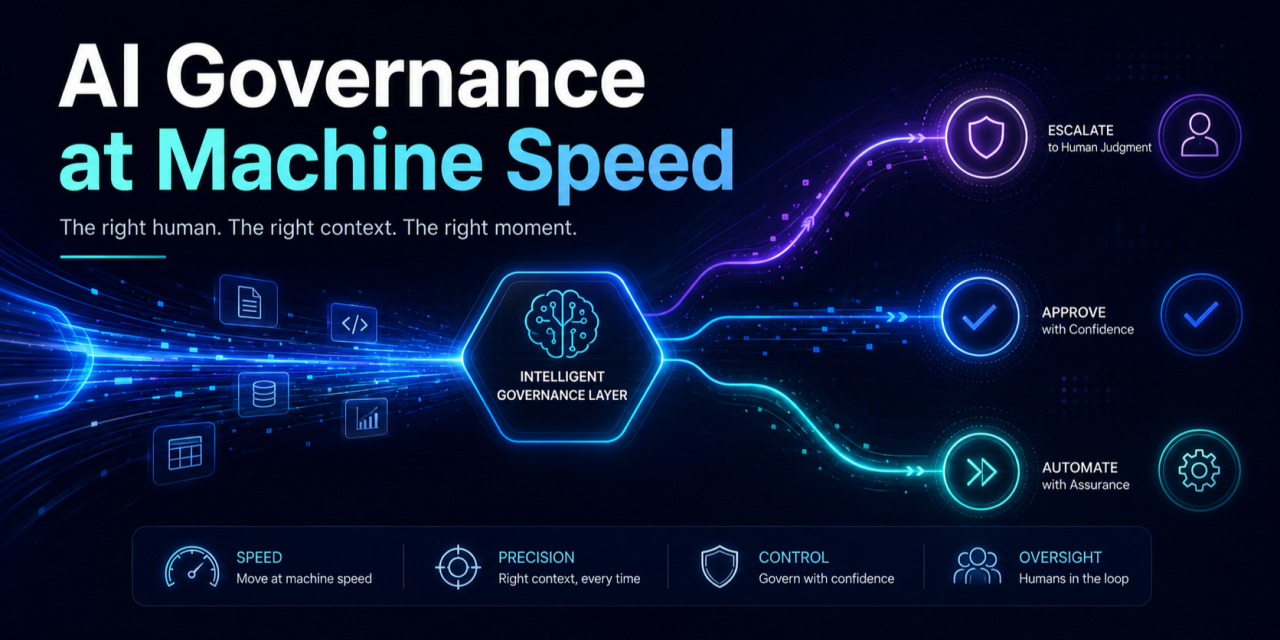
Real governance requires something deceptively simple: the right human, with the right context, engaging at the right moment.
The right human means the person with the authority, expertise, and accountability for this specific decision. Not the first available approver. The person whose judgment actually changes the outcome.
With the right context means arriving at the decision already understanding what the agent did, why it did it, what evidence supports the action, what policy applies, what the consequences of each choice are. Context assembled before the human engages — not reconstructed during the review.
At the right moment means before consequences are irreversible — but not so early the decision is premature, and not so late that the queue becomes a bottleneck.
Documentation of a bad approval is not governance. It is a record of the failure.
The Right Governance Model Is Risk-Tiered
Not everything AI produces requires the same level of oversight. Effective governance recognizes this.
Low-impact, reversible actions should move inside defined policy without human interruption. High-impact, ambiguous, or irreversible actions should be escalated — with evidence, policy linkage, and consequence framing attached. The tier is determined by four factors: potential impact, reversibility, ambiguity, and regulatory exposure.
Routing everything to humans regardless of risk tier is not rigorous governance — it is an attention tax that degrades the quality of the reviews that actually matter.
The Audit Trail Says Yes. It Doesn't Say Why.
There is a failure mode worth naming explicitly: governance theater.
Governance theater is when the system records that approval happened without ensuring the approval was informed. The audit trail shows a green light. What it does not show is whether the approver read the evidence, understood the policy, or had time to engage meaningfully with what they approved.
This failure is accumulating right now in organizations that believe their AI governance is in good shape. They have approval workflows. They have logged outputs. They have policy documents. They have a review step before consequential actions proceed.
What they don't have is a model of whether those reviews are actually providing oversight.
Making Review Quality Measurable
Review completion is easy to measure. Review quality is harder — but it is measurable, and most organizations are not measuring it. Five questions reveal whether governance is informed or theatrical:
1. Was the approver the right accountable person — someone whose judgment actually changes the outcome?
2. Was the evidence sufficient and attached — or did the reviewer have to reconstruct context from scratch?
3. Was the applicable policy or threshold visible — or did the reviewer have to go looking for it?
4. Did the reviewer have enough time and context to decide meaningfully?
5. Was the action reversible, and was that considered before approval was granted?
An audit trail that answers these questions is governance infrastructure. An audit trail that only records that approval happened is documentation.
The Way Forward
Solving this requires accepting that human review is a finite resource — and designing governance architecture around that constraint.
Routing must be selective and risk-tiered. Approval flows must carry context. Review quality must be measured, not just review completion. And the false choice between governance and speed must be rejected — governance is only slow when it is implemented as a brake rather than a routing layer.
AI governance isn't failing because organizations don't care about oversight. It's failing because they're applying a human-speed governance model to machine-speed production.
The fix isn't more documentation. It's smarter routing and higher standards for what counts as informed review. Protect human attention for the decisions that require it. Let everything else move. That is governance that works at AI scale.
Originally published on LinkedIn on August 3, 2026.